Who EECP helps. And how we think about each condition.
The strongest evidence is in chronic angina and heart failure. The same mechanism — improved circulation and endothelial health — applies across a growing range of conditions.
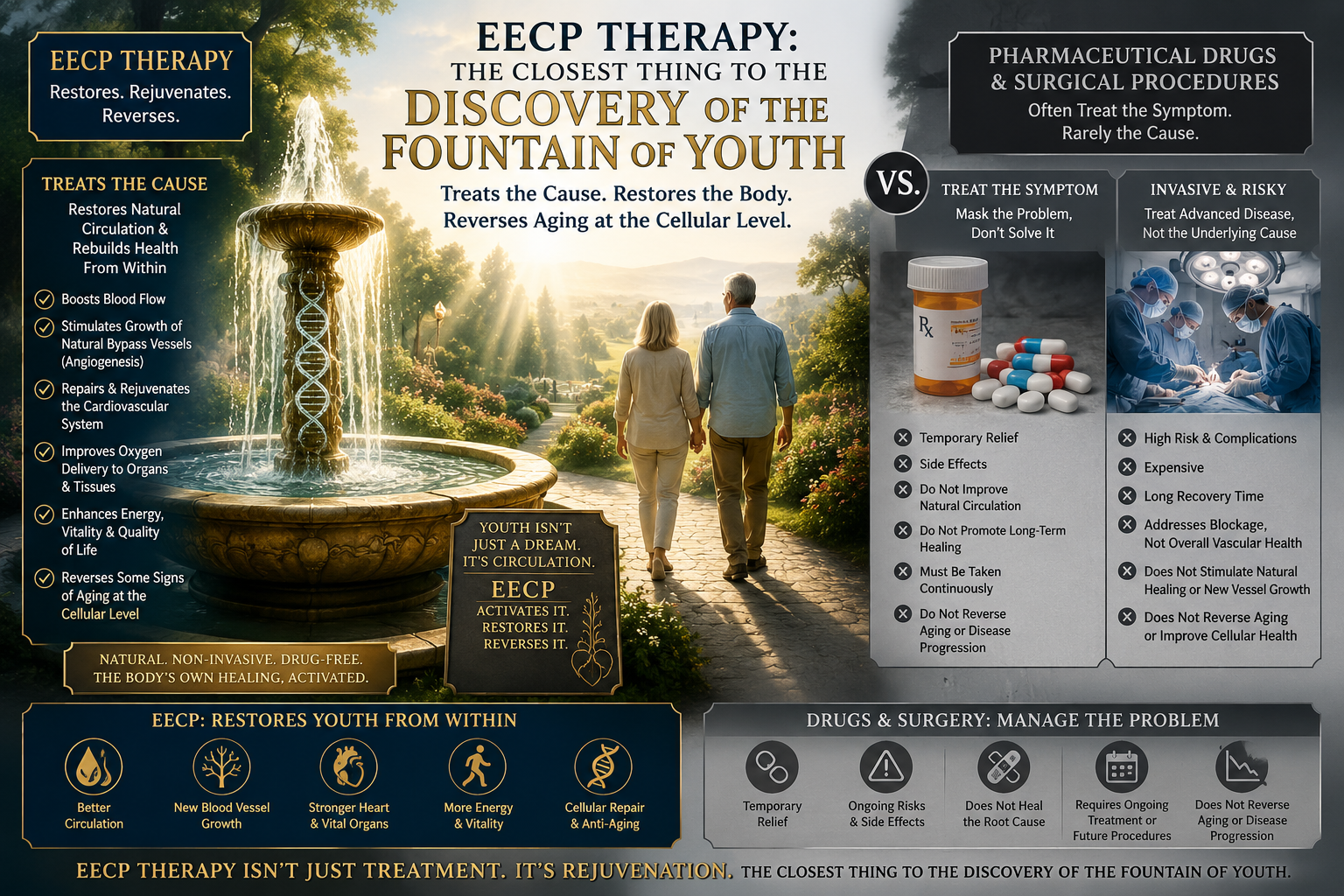
Asheville EECP operates exclusively under the Renew NCP-5's FDA clearance for healthy individuals — for vasodilation, increased VO₂, and improved circulation. We do not use EECP to treat any specific medical condition, and we do not have patients — only clients. The research summaries below reflect the published evidence base for EECP broadly; they are presented for informational purposes only and do not describe what Asheville EECP does or claims to do. See EECPLocator.com for a more extensive list of conditions that EECP providers across the country are using it for.
For a separate, free educational overview of how circulation may relate to a health concern, explore The Circulation Solution. Educational guidance only; it does not provide diagnosis or individualized treatment recommendations.
Chronic & Refractory Angina
For people with ongoing chest pain despite medication, stents, or bypass surgery, EECP is the most evidence-backed non-invasive option available. The MUST-EECP trial showed 78% of patients reported significant improvement in angina class. We operate self-pay — but the evidence is the same.
- — FDA-cleared for chronic stable angina
- — Medicare NCD 20.20 (we are self-pay)
- — Reduces angina frequency and severity
- — Improves exercise tolerance
- — No surgery, no recovery time
Ischemic Heart Failure
The PEECH trial demonstrated that EECP improves exercise duration, quality of life, and NYHA functional class in people with heart failure due to reduced ejection fraction. The mechanism is the same: improved coronary perfusion and endothelial function.
- — Improved exercise duration in PEECH trial
- — NYHA functional class improvement
- — Quality of life improvements
- — Non-invasive — no hospitalization
- — Can be done at home
Post-COVID & Long COVID
The endothelial damage and microvascular dysfunction at the core of long COVID is exactly what EECP addresses. Observational data shows improvement across all eight SF-36 quality-of-life domains. For people with post-COVID fatigue, brain fog, and exercise intolerance, EECP addresses the underlying vascular mechanism.
- — Addresses endothelial dysfunction
- — Improves microvascular circulation
- — All 8 SF-36 domains improved
- — Helps with fatigue and exercise intolerance
- — Growing body of observational evidence
Peripheral Artery Disease
People with PAD experience reduced blood flow to the extremities. EECP's mechanism of promoting collateral vessel growth and improving endothelial function applies directly to peripheral circulation as well as coronary circulation.
- — Improved peripheral blood flow
- — Collateral vessel development
- — Reduced claudication symptoms
- — Non-invasive alternative to procedures
- — Works alongside existing treatment
Diabetic Neuropathy
Diabetic neuropathy is fundamentally a microvascular disease. Improved circulation and endothelial function from EECP can address the underlying mechanism — reduced blood flow to peripheral nerves.
- — Addresses microvascular dysfunction
- — Improved nerve blood supply
- — Complements existing diabetes management
- — Non-invasive
- — Physician clearance required
Healthy & Athletic Wellness
Under the NCP-5's unique third FDA clearance, EECP is used for circulation, vasodilation, and increased VO₂ in healthy individuals. Athletes use it for passive cardiovascular conditioning. Healthy adults use it for circulation and longevity. This is the clearance Asheville EECP operates under.
- — FDA-cleared for healthy individuals (NCP-5 only)
- — Increased VO₂ and vasodilation
- — Passive cardiovascular conditioning
- — Longevity and circulation support
- — No cardiac diagnosis required
Not sure if EECP is right for your situation?
A 30-minute call is the fastest way to find out. We'll give you an honest answer.